- Apr 3, 2025
Confused About Zettelkasten? I Breakdown Everything For You
- Noah Vincent
- Learning
- 0 comments
The Zettelkasten Method.
The famous note-taking method that made Niklas Luhmann a legend - and that allowed him to write 70 books, 400 academic papers, and 90,000 notes.
And with the birth of tools like Obsidian, Roam Research and now Kortex, it became more and more popular.
But there is one issue:
It's complex.
Understanding the whole workflow and process and the goal of each note can be hard to grasp at first, especially when you start.
To be honest - even I, who has been practicing the method for the last 3 years and built a Zettelkasten of over 500 notes - still learn and refine my process and workflow.
That's why in today's email, I'm going to explain to you each step of the process in depth, and especially the main differences between each type of note.
This email was inspired by the questions I've received from an Ark Member, Tomás.
He sent me this:
Hey man! Thank you for your time, I appreciate it :)
So, let me see if I understood:
First, there are the fleeting notes, where I write small pieces of information, phrases, or some random idea.
Then, the literature notes, where those notes are processed with my words, giving them more context, perhaps? But about what?
Then there are the permanent notes, where we turn the literature notes into atomic ideas.
What I don't understand is: is a literature note general, and a permanent note more specific? How?
Finally, the connections. What connects them? The permanent notes with other permanent notes? And what happens to the literature notes after that?
It's not clear to me, sorry ;(
So I will be explaining each step of the process while answering his specific questions along the way.
Let's begin.
Understanding The General Process
The first thing to understand with Zettelkasten is that there are 3 types of notes and four steps to this process.
The 3 types of notes are:
Fleeting Notes → Quick capture of ideas using Capture inside Kortex, thoughts, highlights taken from articles or books, quotes, tweets, etc.
Literature Notes → Notes where you'll transform the raw information from your fleeting notes into your own interpretation by writing the concepts with your own words
Permanent Notes → Notes that you'll create from your Literature Notes, respecting the Atomicity Principle, which states that One Note = One Big Idea.
The 4-step process:
You create fleeting notes by capturing ideas using the capture feature inside Kortex or highlighting content from books, articles, videos, quotes, tweets etc.
You create literature notes where you'll transform the content of all the fleeting notes from one source inside the document by writing it with your own words.
You create permanent notes from your literature note by extracting each different idea you've reformulated into single notes.
You connect your permanent notes together.
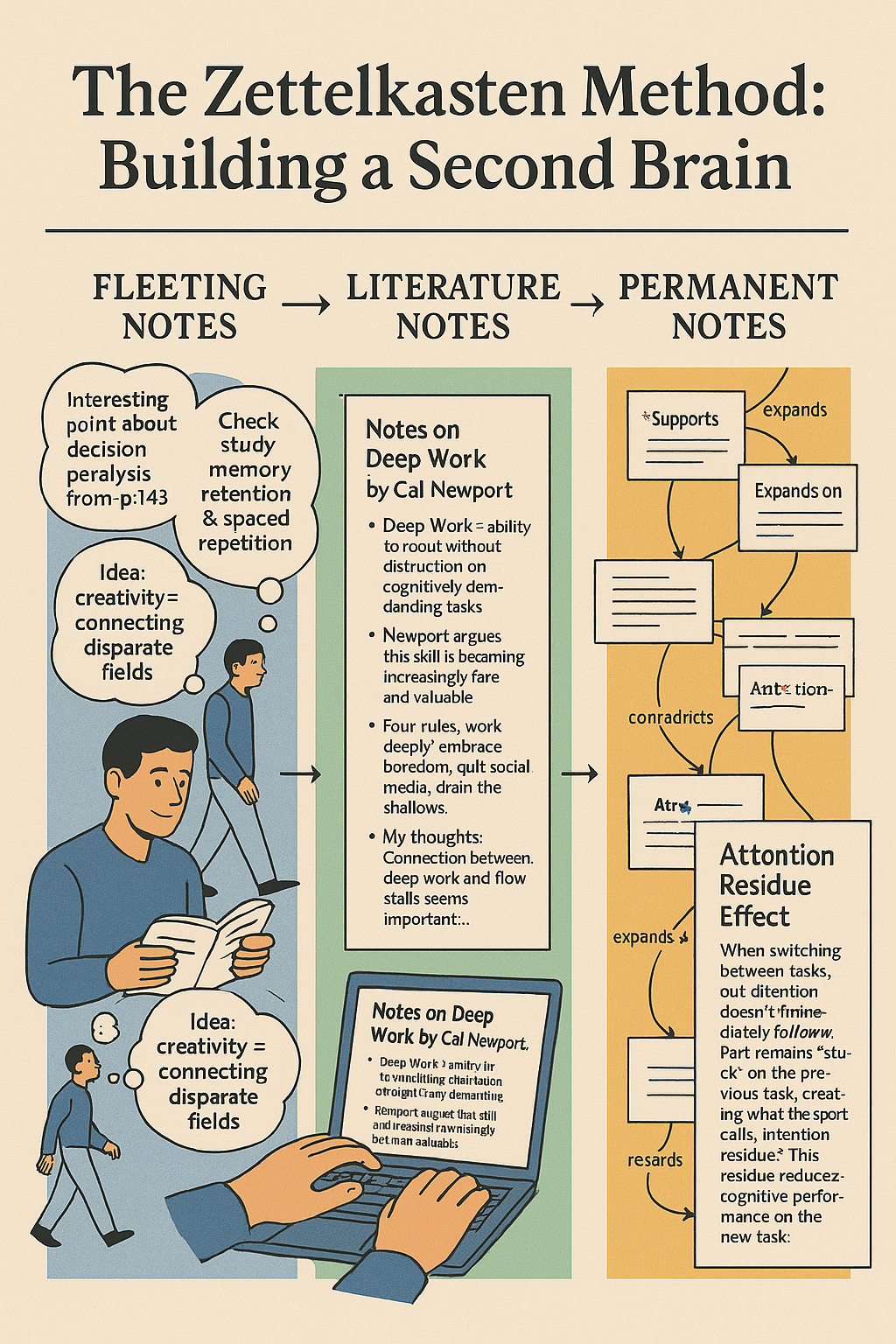
I asked Sora to help me create a diagram to show the process lol
This is it for the theory.
Now let's see how this really applies in practice inside Kortex:
The Zettelkasten Method in Practice inside Kortex
Step 1: Fleeting Notes
Everything starts with fleeting notes.
I will highlight interesting paragraphs from books, articles, podcasts, and YouTube videos.
I use 3 different tools for highlighting:
Kindle for books
Reader by Readwise for articles, PDFs and videos
Snipd for podcasts
These 3 tools are synced to my "highlight hub" which is Readwise.
And Readwise is connected to my Kortex library, allowing me to have access to all of my highlights directly inside Kortex.
If you want to see in more detail how my highlighting system works, click on this video article where I show everything in detail.
At this point, I'll have different highlights on multiple sources that I have taken during my learning and reading sessions.
When it's time to really go in-depth, I'll go to step 2:
Step 2: Literature Notes
Now it's time to work on my highlights and rephrase each idea and concept with my own words.
Let's take for example the latest Naval Ravikant Podcast with Chris Williamson.
I will create a new Literature note titled "Naval Ravikant - 44 Harsh Truths About Human Nature"
Inside this literature note, I'll rewrite the highlights I find the most interesting with my own words.
For example, I have this highlight that I've created using Snipd:
Suffering and Reward
- Most gains in life come from short-term suffering, leading to long-term rewards.
- Avoid becoming a suffering addict; attach well-being to the outcome, not the pain itself.
Transcript:
Chris Williamson
One of yours most of the gains in life come from suffering in the short term, so you can get paid in the long term. I think that's classic. Winning the marshmallow test on a daily basis. But there's an interesting challenge where I think people need to avoid becoming a suffering addict, sort of using suffering as the proxy for progress as opposed to the outcome of the Suffering, right? It's like I was in pain, not eating the marshmallow. I was in pain doing this work. I have attached well-being and satisfaction to pain, not to what the pain gets me on the other side of it.
I will rewrite this idea with my own words.
It would look something like this:
Don't become addicted to the pain of the grind.
Most rewarding actions imply suffering in the short term to be rewarded in the long run, but the trap is to become addicted to the short-term pain to the point where you become unconsciously so attached to it that you start seeking the pain instead of the reward of the pain.
When you do that, you'll lose sight of your long-term vision and it'll hinder your ability to be happy and grateful for the present moment. This energy also isn't optimal to create meaningful work and impact people.
Seeking this pain can become a form of dealing with inner trauma of low self-esteem and actually feed your feeling of not being enough.
This is my own interpretation of the highlight.
I've added some thoughts and understanding from my own knowledge to the original point.
Tomás's question on literature notes was:
Then, the literature notes, where those notes are processed with my words, giving them more context, perhaps? But about what?
Your literature notes are your working document where you create your own thoughts and interpretations from others' thoughts.
You'll add your own interpretation, experience and examples to create your own original idea from your highlight.
Then you'll go through this process for each of your highlights inside your literature notes.
At the end of the process, your literature notes contain multiple ideas rephrased with your own words.
In the case of Naval's podcast, considering the title implies 44 harsh truths, I could have 44 different ideas that I've written myself from my highlights.
Inside Kortex, I like to separate each different idea inside a literature note using elements to make the distinction clearer.
If you want to access all of my Kortex Templates to build your own Zettelkasten, including literature & permanent note:
Click here to access Noah's Ark Bank.
Then after processing all of my highlights I'll move on to step 3:
Step 3: Permanent Notes
What I'll do now is open my literature note, and start extracting each idea into its own separate, atomic note.
I'll duplicate my permanent note template, name it, and fill the "big idea" section with the description of the idea that I've written in my own words from my literature note.
Then I'll expand on this note in the Reference section by adding quotes, examples, or different perspectives on this idea.
Tomás question on permanent note was:
Then there are the permanent notes, where we turn the literature notes into atomic ideas.
What I don't understand is: is a literature note general, and a permanent note more specific? How?
So to answer your question, a permanent note is more general as it is the description of the big idea in your own words, whereas a literature note will be specific to a source or piece of content.
Then it's time for the last step:
Step 4: Connections
At this point, I'll add links using the [[]] feature inside Kortex to connect other documents related to this note.
To do this, I'll use my trigger questions to help me find connections which are:
How does this note fit into what I already know (in my other notes)?
How can this note explain another concept already in my system?
What idea contradicts this idea?
Why am I attracted to this idea (apart from confirmation bias)?
If we change the author's perspective, does this note evolve?
What are the applications that I will have of this concept?
Most of the time, I'll also write connections directly inside the description of the note as well, so I'll end up from 1-2 to 5-6 different connections.
Now, if you want to make sure your Permanent Note is well-made, here are 5 rules to follow:
5 Key Rules for Effective Permanent Notes
-
Brief and Concise
Limit to a single screen without scrolling
Synthesize complex ideas into their essence
Brevity enhances discoverability and memorization
-
Truly Atomic
Focus on exactly one concept per note
Cover that single concept completely
Avoid diluting with multiple ideas
-
Properly Sourced
Always link back to your literature note
Maintain connection to original context
Create clear provenance for your ideas
-
Self-Contained
Must be fully understandable on its own
Should make sense even years later
No reliance on other notes to grasp the concept
-
Richly Connected
Include links to related notes, examples, and references
Explain connections with future self in mind
A note's value grows exponentially with its network of connections
So to answer your final question Tomás, which was:
Finally, the connections. What connects them? The permanent notes with other permanent notes? And what happens to the literature notes after that? the permanent notes are linked together.
The literature note stays in your main note folder and is used as a source for your permanent note.
Because it's a bottom-up structure, there are no hierarchies of notes inside your note folder.
Every note is at the same level, whether that be permanent or literature note.
Conclusion
My key advice for you is to start practicing and find your own way to apply the method.
Adapt it to what feels natural to you.
For example, I like to use Google NotebookLM to help me write synthesis from my book highlights.
Because I have hundreds of highlights, I'm not going to rewrite each of them in my own words, it would be too tedious.
So I use NotebookLM to help me create synthesis of my highlights, which helps me reference them, and identify the key big ideas I want to extract in a permanent note.
Then I directly create a permanent note and skip the whole literature note process entirely.
You have to see literature notes as working documents to help you go from the author's thoughts to your own thoughts.
But this is not rigid.
If you want to directly create a permanent note and skip the literature note process, go for it.
Do not feel the need to rewrite ALL of your highlights as well.
Only focus on what's most important to you.
The more you'll use the system, the more you'll find your own way that makes sense for you.
What's important is that you follow the main guidelines and principles of the method and write everything by yourself.
As soon as you use AI to write your notes for you and start copy-pasting stuff - you've lost.
Remember what I wrote in yesterday's newsletter about the 7 Neuroscience Hacks for Superhuman Learning.
You want to stay actively engaged with the learning material to memorize it and absorb it.
That's how you develop a true quality of thinking.
Anyway, I hope this email answers your questions Tomás.
I thank you for reaching out to me directly, I like answering questions because it's a free email subject and it gives a lot of value because you're probably not the only one who feels confused about this stuff.
If any of you who read these lines has specific questions and wants me to answer them, feel free to reply to this email and I'll dedicate an email answering it!
I wish you an amazing day,
Thanks for reading
And welcome back to Noah's Ark.
Noah.