- Feb 14, 2025
The Note-Taking System That Can Turn Anyone Into A Genius
- Noah Vincent
- Learning
- 2 comments
You can watch the video version here ↴
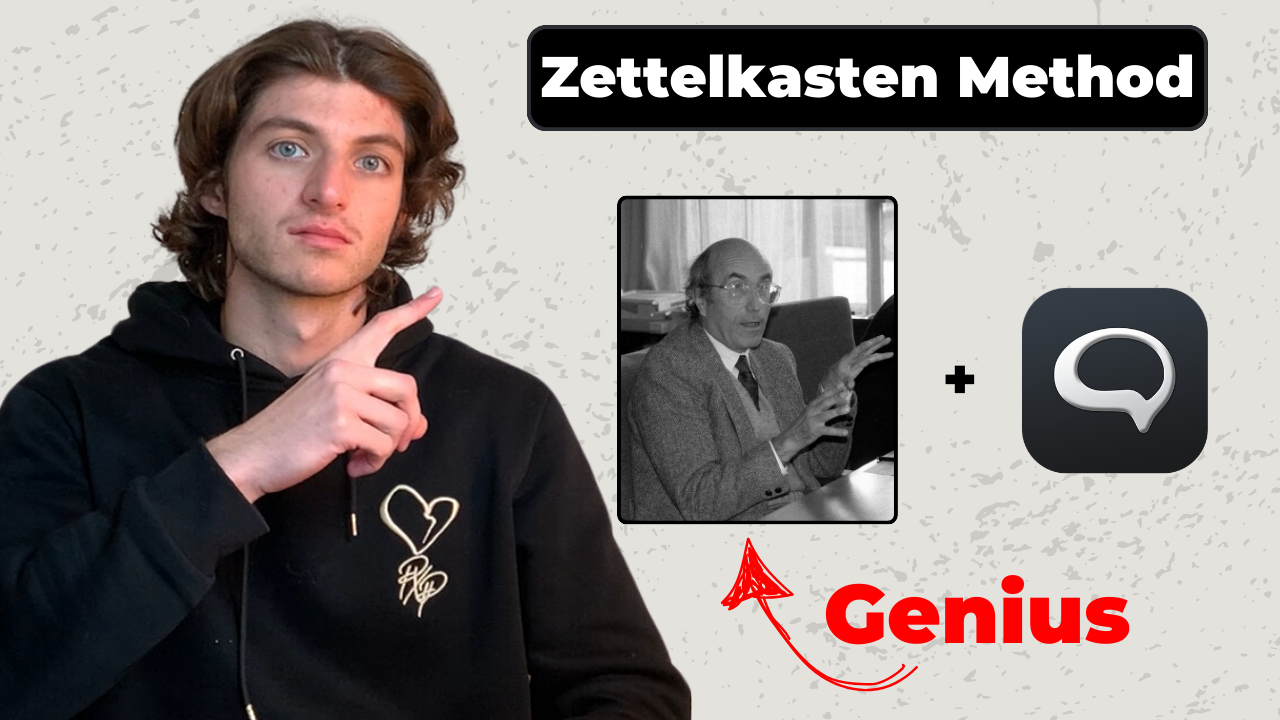
Imagine creating 70 books, 400 academic papers, and 90,000 notes throughout your career.
Now imagine doing it all with nothing but paper cards and a wooden box.
This is exactly what Niklas Luhmann accomplished, becoming one of history's most prolific scholars—a feat that remains impressive even by today's technological standards.
But Luhmann wasn't just productive.
He was considered a genius by his peers, developing groundbreaking theories across an astounding range of fields: law, economics, politics, art, religion, ecology, mass media, and even love.
His ability to make unexpected connections between these diverse domains made him one of the most influential social theorists of the 20th century.
Here's what's fascinating:
Luhmann wasn't born a genius.
What made him extraordinary wasn't his IQ or natural talent-it was his system.
He created the Zettelkasten Method, a revolutionary approach that allowed him to develop unique insights and generate new ideas at a level that seemed superhuman to his peers.
While his contemporaries struggled to publish a few papers a year, he was averaging one published work every three weeks.
If Luhmann could achieve all this with paper cards...
Imagine what's possible with modern digital tools.
But before we explore those possibilities, we need to understand why our current approach to note-taking is fundamentally flawed.
The Problem with Traditional Note-Taking
Think about your own experience:
How many highlights have you taken that you've never looked at again?
How many notebooks are sitting on your shelf, filled with ideas you've completely forgotten about?
Most people's note-taking system looks something like this:
They read a book, highlight some passages, maybe write a few notes in the margins... and then what?
The book goes back on the shelf. The highlights sit in their Kindle app. The notes gather dust in various notebooks and apps.
This is what I call 'Dead Notes Syndrome', and it manifests in four critical problems:
1. Isolated Notes
Your notes remain disconnected and scattered. Book highlights in your Kindle app, random thoughts in your Notes app, article highlights across different tools—it's like having puzzle pieces spread across different rooms. How can you see the bigger picture when everything is disconnected?
2. Neglected Reviews
Let's be honest—when was the last time you actually went back to review your highlights from that book you read last month? Without a system for review, your notes become digital waste, taking up space but providing no value.
3. Unusable Content
Even when you do find your old notes, they often lack context. You might find a brilliant quote, but you can't remember why you saved it or how it connects to your work. It's like having a library where all the books are in random order—sure, the knowledge is there, but good luck finding it when you need it.
4. Inconsistent Systems
One day you're using Notion, the next day you're trying Evernote, then you're back to paper notebooks.
Each system is different, making it impossible to connect ideas across platforms.
The problem isn't that you're taking notes-it's how you're taking them.
Without a proper system, your notes are nothing but a cost—a liability—a complete waste of your time and energy.
But with an integrated system like the Zettelkasten method, note-taking becomes a true investment.
Each note you take doesn't just retain its value—it appreciates over time, becoming an asset for your thinking.
Better yet, every new note you add multiplies the value of your existing notes by creating new connections and sparking unexpected insights.
This is exactly what made Luhmann's system so revolutionary.
While others were drowning in disconnected notes, he built a second brain that could generate insights on demand.
His Zettelkasten wasn't just a collection of notes—it was a living, growing system that could think with him.
The Zettelkasten Method Explained
The Zettelkasten method, German for 'slip box', is more than just a note-taking system:
It's an external thinking framework that compensates for the limitations of our brain.
Instead of trying to remember everything or hoping you'll somehow find that note you took six months ago, it provides a reliable structure for storing, connecting, and developing ideas.
Think of it as building your own personal idea laboratory.
Just like Luhmann did, you're creating a system where ideas can interact with each other, combine in unexpected ways, and generate new insights automatically.
The method breaks down into four simple but powerful steps:
1. Fleeting Notes
These are your raw materials-quick captures of information, highlights, random thoughts, or interesting quotes you come across. They're like collecting ingredients for a recipe-they're not the final dish, but they're essential building blocks. Every highlight you make, every sudden idea you jot down, starts as a fleeting note.
2. Literature Notes
This is where you take those fleeting notes and begin processing them. You're not just copying information-you're digesting it, rewriting it in your own words, and making it yours. It's like taking those raw ingredients and starting to prepare them for cooking. Literature notes are your way of ensuring you truly understand what you're capturing.
3. Permanent Notes
This is where the magic starts happening. You break down your literature notes into atomic ideas-one note, one concept. Each permanent note is like a LEGO brick that can connect with others in countless ways. This is what Luhmann called the principle of atomicity, and it's crucial for building a system that can generate insights. A permanent note should be self-contained enough to make sense on its own, but open-ended enough to connect with other ideas.
4. Connections
This is where your system comes alive. You start linking your permanent notes together, creating a web of interconnected ideas. Each new connection can spark insights you would never have thought of otherwise. This is how Luhmann could write about such diverse topics-his system could show him connections between ideas that seemed completely unrelated.
The beauty of this method lies in its simplicity. While each step is straightforward, the combination creates a powerful system that can transform how you think and create. It's not just about storing information-it's about creating a system that helps you think better.
6 Powerful Benefits of the Zettelkasten Method
When you implement the Zettelkasten method properly, six powerful benefits emerge that transform how you think, learn, and create:
1. Better Note Utilization
Instead of having a graveyard of forgotten notes, you're building a living library where every note is discoverable and usable. Your notes actually work for you instead of collecting digital dust. Each time you create a new note, it becomes part of an active, interconnected system rather than another item lost in the void of your digital archives.
2. Enhanced Retention Through Spaced Repetition
Every time you make a connection between notes, you're naturally reviewing and reinforcing your knowledge. You're not just storing information—you're processing it in a way that helps it stick. This natural form of spaced repetition helps combat the forgetting curve, ensuring that your knowledge becomes deeply embedded in your understanding.
3. Idea Generation Through Connection
This is where it gets really exciting—you start experiencing what is called 'ideas sex.' When your notes are properly linked, new ideas literally emerge from the connections. This is exactly how Luhmann could write about such diverse topics—his system would show him connections between ideas that nobody else could see. The network effect of your notes creates a compound interest of knowledge, where each new connection multiplies the value of your existing notes.
4. Deeper Understanding
Through what psychologists call the 'generation effect,' you develop a richer comprehension of everything you learn. Because you're constantly rewriting ideas in your own words and connecting them to what you already know, you're not just collecting information—you're truly understanding it. This active engagement with your notes transforms passive knowledge into active wisdom.
5. Accelerated Content Creation
When you sit down to write, you're not starting with a blank page—you're starting with a network of developed ideas ready to be assembled. This is how Luhmann could publish a new work every three weeks—he wasn't writing from scratch, he was assembling ideas his system had already developed. Your note system becomes a content creation engine, making writer's block a thing of the past.
6. Development of Original Insights
Instead of regurgitating what others have said, you're creating new combinations of ideas that nobody else has put together before. Your notes stop being a record of other people's thoughts and become a tool for developing your own original insights. This is perhaps the most powerful benefit—the ability to generate truly original thinking through the systematic connection of ideas.
These benefits don't just happen automatically—they require a proper system and tool to implement the Zettelkasten method effectively. That's where Kortex comes in.
Kortex: The Perfect Digital Home for Your Zettelkasten
If Luhmann could achieve all this with paper cards, imagine what's possible with modern digital tools. But here's the challenge—most note-taking apps aren't designed for this kind of interconnected thinking. They're either too complex, too rigid, or they separate your notes from your writing, breaking the creative flow.
This is exactly why Kortex is such a game-changer. It's like what would happen if Obsidian and Notion had a baby—but specifically designed for creators and writers who want to transform their notes into valuable output.
What makes Kortex perfect for the Zettelkasten method are three key features:
1. Centralized Knowledge Hub
Your notes, highlights, writing, and ideas all live in one place. No more switching between apps or losing your train of thought. The Library feature in Kortex automatically syncs with Readwise, bringing all your highlights from books, articles, and other content into one searchable database. These become your fleeting notes—the raw material for your Zettelkasten.
2. Powerful Connection System
Just like Luhmann's slip box, Kortex lets you link ideas effortlessly, creating that network of knowledge that makes the Zettelkasten method so powerful. You can:
Create bi-directional links between notes
View all connections in a document's properties
Open multiple notes side by side in panes
Use tags to create flexible organizational systems
3. Seamless Content Creation
Unlike other note-taking apps, Kortex understands that your ultimate goal isn't just to take notes—it's to create content. The app bridges the gap between note-taking and content creation with features like:
Customizable elements for different types of notes
Templates for literature notes and permanent notes
A capture system for quick ideas
Multi-pane viewing for referencing notes while writing
How I Use Kortex for Zettelkasten
Let me share how I've implemented each step of the Zettelkasten method in Kortex:
Fleeting Notes
Everything I read, watch, or listen to gets captured in my Kortex library. Using Readwise integration, all my highlights from Kindle books, articles, and even podcast transcripts automatically sync to Kortex. For random ideas or insights, I use the Capture feature, which lets me quickly jot down thoughts and tag them for later processing.
Literature Notes
When I'm ready to process my fleeting notes, I use Kortex's customizable elements to create structured literature notes. I have a template that includes sections for:
Metadata (source, author, date)
Key highlights
Summary in my own words
Main concepts to extract
The multi-pane system lets me view my highlights on one side while writing my summary on the other, making it easy to process information without constantly switching contexts.
Permanent Notes
For permanent notes, I use another template that enforces the principle of atomicity—one note, one concept. Each permanent note includes:
A clear title that expresses the main idea
The concept explained in my own words
References to source material
Connections to other notes
Tags for organization
Making Connections
This is where Kortex really shines. When writing, I can:
Open multiple notes side by side
Create links between related ideas
View all connected notes in the properties panel
Use tags to find related concepts
Navigate through my web of knowledge effortlessly
Ready to transform your note-taking into a powerful system for generating insights?
You can get started with Kortex for free. The base features—everything you need to implement the Zettelkasten method—are completely free to use.
Your Next Steps: Access Noah's Ark Bank
I know implementing a new system can feel overwhelming at first.
That's why I've created Noah's Ark Bank—a complete collection of everything you need to build your Zettelkasten system in Kortex.
Inside Noah's Ark Bank, you'll get:
Three Complete Step-by-Step SOPs
Content Acquisition: How to configure your Library and build a powerful knowledge base
Zettelkasten Implementation: A detailed guide to applying the method in Kortex
Content Creation: Transform your notes into high-quality written content
Eight Powerful Kortex Templates
A complete collection of templates for:
Building your personal Second Brain
Taking effective notes from any source
Creating both short and long-form content
Organizing your knowledge systematically
Three Essential Tools
Tag Taxonomy System: A structured approach to organizing your notes and files
Copywriting Structures: Plug-and-play frameworks for better writing
Priority Task Framework: Define and focus on your highest-impact work
The best part?
Noah's Ark Bank is completely free.
It's my way of helping you avoid the months of trial and error I went through while developing these systems.
Click here to access Noah's Ark Bank for free
Remember what we learned from Luhmann—genius isn't born, it's built through systems.
Now you have everything you need to build yours:
A proven method that has stood the test of time
A powerful tool designed specifically for this purpose
A complete implementation guide with all necessary templates
Feel free to ask me any question in the comment of this article - or inside the Kortex Discord community.
Thanks for reading,
And welcome to Noah's Ark.
Noah

2 comments

The korenote system is just a flavour of the original zettelkasten, but still follows the three rules of a zettelkasten, but also expands onto deeper perspective and knowledge development through elements, that are the lego of a zettelkasten that allows us to view our ideas from different angles.
Yeah, korenotes are basically fancy permanent notes