- Feb 12
how to (actually) beat procrastination forever (The 4 Quadrant Framework)
- Noah Vincent
- Productivity
- 0 comments
1) Introduction
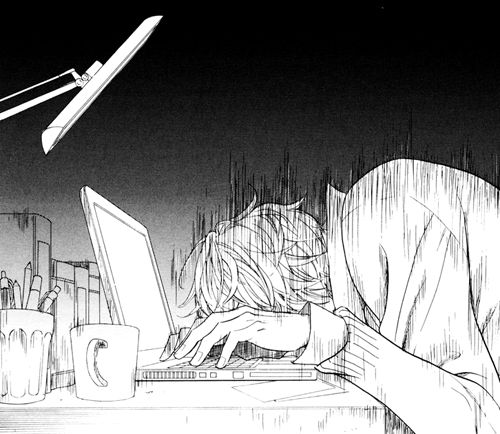
When you really think about it, procrastination is paradoxical.
Why don’t we just do the things we actually want to do?
Obviously there are many reasons for that. But when you step back and really think about it, it makes no sense. If you want to do something, you should just do it. If you know something is good for you and important for you, you should just do it right now.
But yet that's not what happens. Because there are actually major forces going on, both external and internal, that influence you and lead you to procrastinate.
That's why in this article we're going to analyze procrastination through Ken Wilber's Four Quadrants framework in order to look at the problem from multiple perspectives. Because most content on this topic only addresses one of those perspectives, and that's why it's incomplete. That's why, despite having watched 60,000 productivity videos on how to beat procrastination, you still haven't beaten it.
The goal of this article is to give you the keys to understanding procrastination so that you can stop being a victim of it. These keys will allow you, whenever you procrastinate, to analyze the situation in a way that helps you bounce back and actually stop procrastinating. You'll learn more about yourself and transform every experience of procrastination into an opportunity for learning and growth, which will allow you to constantly progress toward embodying your Higher Self.
So grab a coffee, take your time, and let's dive in.
If you want to watch the video version of this article, click here:
2) The Framework: Ken Wilber's Four Quadrants
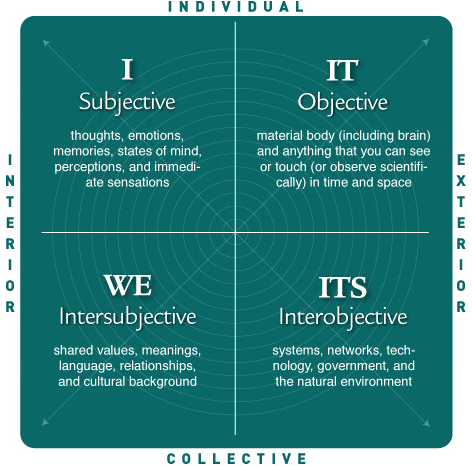
Ken Wilber's model says that any human phenomenon can be understood through four lenses.
Upper Left: Interior-Individual (Subjective / Spiritual). What you feel, think, believe. Your inner world. In the case of procrastination, it's everything that relates to your values, your vision, your alignment with the task you're procrastinating on, and all the internal conflicts going on.
Upper Right: Exterior-Individual (Objective / Physical). What's observable and measurable in an individual. Your brain chemistry, your dopamine levels, your habits, and your concrete systems.
Lower Left: Interior-Collective (Cultural / Intersubjective). The shared beliefs, narratives, and cultural norms you swim in every day without realizing it. Hustle culture, comparison, perfectionism, the "passion-preneur" myth that we're going to debunk later.
Lower Right: Exterior-Collective (Systemic / Interobjective). The infrastructure, platforms, systems, and structures that surround you digitally and physically. Social media algorithms frying your brain, the attention economy built around making you addicted to content, and your entire digital environment.
Procrastination is never just one problem. It's always a combination of all four quadrants. If you only fix one, the other three will pull you right back in. They're all interconnected, so when you work on one quadrant it influences the others. But that's why in this article we're going to analyze procrastination and find solutions across all four quadrants, so you can actually beat it forever.
3) Upper Left: Procrastination as a Spiritual Problem
The Alignment Test: Do You Actually Want to Do This?
When you are genuinely aligned with an action, when it comes from a deep, authentic desire, you don't need to force yourself. It flows. It's natural. It's almost effortless.
Think about it: when was the last time you procrastinated on something you were truly excited about? Probably never. You just did it.
So if you're procrastinating, one of two things is happening.
Scenario A: You don't actually want to do it. You've convinced yourself you "should" do it. Maybe some guru on YouTube told you to start a podcast, or a mentor said you need to do cold outreach, or a book told you to wake up at 4 AM every day. But deep down, it's not your desire. It's an external authority you've internalized as your own goal.
In this case, procrastination is actually a healthy signal. Your brain is telling you this isn't your path. The move here is to question the legitimacy of the action. Where does this obligation come from? Is it aligned with your vision, your values, and what you really want out of life? Or are you chasing someone else's dream?
Scenario B: You genuinely want to do it, but you can't seem to start. You know you want to create content, you know you want to build your business, but something invisible is blocking you. This signals an internal conflict. A part of you wants to move forward, but another part is resisting. It can be fear of judgment, impostor syndrome, fear of failure, or even fear of success.
The move here is to identify the conflict. A very practical exercise: ask yourself "what are all the benefits for me NOT doing this task?" Maybe you'll realize that not creating content allows you to spend more time with your kids, which reflects that you value family deeply right now and don't want to sacrifice those moments. In that case, maybe you need to create content at another time, or find a way to honor both values without sacrificing either. Asking this question will help you find better alignment with the task.
Higher Self vs. Lower Self

Napoleon Hill, in Outwitting the Devil, describes two forces inside every person.
The Higher Self is the version of you connected to your vision, that acts with intention, that moves toward your goals with clarity and purpose. This is the voice that knows exactly what you need to do. The part of you who is unafraid, resolute, and decisive.
The Lower Self is the part that seeks comfort, avoids pain, and is driven by fear and ego. This is the voice that says "do it tomorrow," "just one more video," "you deserve a break." You tell yourself you'll scroll for 15 minutes and it ends up being two hours. The Lower Self seeks instant gratification and leads you to the habit of drifting. Drifting means you're not aligned, not decisive, and not intentional.
Procrastination is what happens when your Lower Self wins the daily battle against your Higher Self. Which self rules depends on the dominant nature of your thoughts. Positive thoughts and emotions give control to your Higher Self. Negative thoughts and fear give control to your Lower Self.
The question becomes: which voice are you feeding?
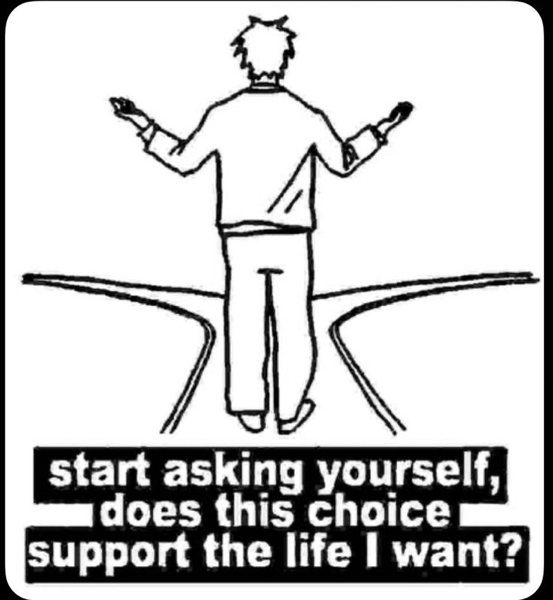
If you're feeding your Lower Self with negative thoughts and fear, it will give control to your ego, which will seek instant gratification and pull you into every bad habit you want to avoid. But if you're cultivating gratefulness, joy, harmony, and peace with specific daily practices, you will embody your Higher Self in your daily life.
The Hawkins Scale: Your Frequency Determines Your Capacity for Action
David Hawkins mapped human consciousness on a scale from 0 to 1,000. What I love about this map is the simple idea that the lower your emotions, the lower your frequency, and the more incapable of action you become:
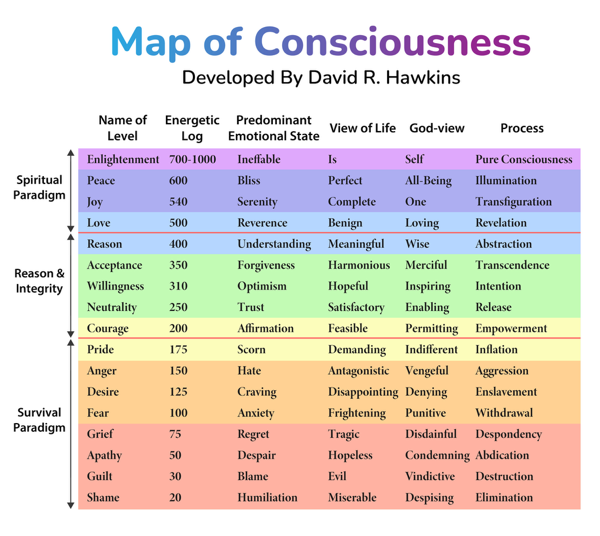
Below 200 are the contracted states: shame (20), guilt (30), apathy (50), fear (100), anger (150). These are low-energy states where action feels impossible.
200 is Courage, the tipping point. This is where action becomes possible because you start believing you can change things.
Above 200 are the expansive states: willingness (310), acceptance (350), reason (400), love (500), joy (540), peace (600). The higher you go, the more natural and effortless action becomes.
When you're operating below 200, you literally don't have the energetic capacity to take action. Procrastination isn't a choice at that point. It's a consequence of your vibrational state.
When we analyze procrastination through this lens, the question shifts from "how do I force myself to work?" to "how do I raise my frequency so that action becomes natural?"
Upper Right: Procrastination as a Physical Problem

The Psychological Triggers That Make Tasks "Procrastinable"
Research in psychology identifies several characteristics that trigger procrastination:
If a task is boring and doesn't stimulate your brain enough, you're going to procrastinate.
If it's frustrating because you don't know where to start or feel stuck, you're going to procrastinate.
If it's too difficult and the cognitive load is too high, same thing.
If it's ambiguous and you don't know exactly what to do, unstructured because there's no clear process to follow, or has no immediate reward because the payoff is too far in the future, you're going to procrastinate.
And if it lacks personal meaning and you don't see why you should do it based on your values and worldview, of course you're going to procrastinate. That last one connects right back to the Upper Left quadrant.
Each of these triggers has a concrete solution. But first, there's a bigger problem hiding underneath.
The Dopamine Problem: Your Motivation Engine Is Fried
You already know about this because every creator on earth has talked about it. But dopamine is the molecule of anticipation and motivation. It gives you the drive to move toward an action.
If you overstimulate your dopamine system with artificial spikes (social media, video games, porn, infinite scrolling, notifications), your brain recalibrates its baseline. Normal activities like working, creating, reading, thinking, walking no longer produce enough dopamine to motivate you. The result is that you're physically incapable of taking action. Your brain is running a motivation deficit for the things that actually matter.
And here's what's interesting: most of the time, you indulge in instant gratification and cheap dopamine when you lack alignment with your Higher Self. So we come back to the Upper Left quadrant. That's why I believe procrastination is ultimately, mostly, a spiritual problem. But all of these are interconnected.
If you're not feeling connected to your purpose, your why, and you don't have a clear vision of your goals, then of course you're going to indulge in cheap stimulation. And it's incredibly easy to do so with all the technology we have nowadays. So you fry your dopamine, and it becomes even harder to take action toward your goals.
The Mental Bandwidth Problem
If your mind is cluttered with notifications, unread messages, open browser tabs, and mental loops about social media, there's no bandwidth left for creation. Taking action requires focus. Focus requires space. If your brain is running at 80% capacity before you even start working, you only have 20% left for the work that matters.
This is actually a psychological principle called the Zeigarnik Effect: we remember unfinished tasks better than finished ones. All the open loops from your phone (unread messages, notifications, half-started tasks) overload your mental RAM and prevent you from thinking clearly and creating. It's exactly the same as with a computer. If you open too many tabs and applications, you run out of RAM and everything starts lagging.
That's why you need systems to manage your tasks, projects, and goals, and free your mental bandwidth.
Lower Left: Procrastination as a Cultural Problem

Toxic Productivity Culture
We live in a world where "grind 24/7" is glorified and hustle porn is everywhere. Paradoxically, this creates more procrastination, not less.
When the standard is "work 16 hours a day like Elon Musk," anything less feels like failure. So you set impossible standards for yourself, feel overwhelmed by the mountain, and end up doing nothing at all. This leads to negative emotions like shame and guilt, which, as we've seen with the Hawkins scale, lower your frequency, make you incapable of action, activate your Lower Self, and push you toward instant gratification that fries your dopamine even further.
Cultural perfectionism is one of the biggest hidden drivers of procrastination. It drives negative emotions, shame, and self-sabotage. And it's a perfect example of how all four quadrants are interconnected.
The "Passion-preneur" Narrative

There's this idea that if you follow your passion, you'll never work a day in your life. This creates a dangerous implicit belief: if it's hard, it must not be your passion, so you should quit.
The reality is that even the most aligned work has boring, frustrating, and difficult moments. Editing videos can be tedious. Answering emails is boring. Building systems is repetitive. Sometimes you have low months and it's hard to bear the stress.
But if the cultural narrative tells you that it should feel magical every second, you'll second-guess what you're doing and start thinking "maybe this isn't aligned with me," when in reality it's just part of the process.
You procrastinate here not because the work isn't right for you, but because the culture taught you that aligned work should feel effortless 100% of the time. In a way, that's true: if you find your life's work, you won't "work" in the bad sense. But that doesn't mean it won't require effort and energy. When you're aligned with your Higher Self, it becomes easy to put in the effort necessary toward your life's mission, because the feeling of joy, alignment, and fulfillment drives you.
But let's be honest. Being a creator, being an entrepreneur, building your business, all of that is scary. It demands you to take risk. It means you will have moments of low income and financial stress. That's part of the process and you have to embrace it. That doesn't mean it's not what you're meant to do.
The Comparison Trap

When you see creators posting every day, building audiences effortlessly, and seemingly doing everything without breaking a sweat, it creates a gap between where you are and where you think you should be. That gap generates shame. And shame sits at the very bottom of Hawkins' scale, around 20. It's one of the most paralyzing emotions a human can experience.
When you're constantly seeing testimonials of people going from zero to 10K a month and you've been creating for six or twelve months and you're still at zero, it feels awful and makes you procrastinate. That's why I'm very big on deleting social media and protecting your peace from all that noise. It will only lower your frequency and make it harder to take the action that will actually generate abundance in your life.
Option Overload and FOMO
The current culture glorifies being multi-passionate and having multiple income streams. It's even worse with AI nowadays, with this constant AI FOMO.
The result is that you have 15 possible projects in your head, you can't fully commit to any single one, and you procrastinate because choosing one thing means letting go of everything else. But there is only with focus that you can build something meaningful. The paradox of choice is real: the more options you have, the less likely you are to act on any of them.
You need to take a definite decision and focus on one project. That's why I work in sprints and create quarterly goals. Define your priority for three months, iterate, then take a step back, reflect, and adjust. But always work on one thing at a time.
Lower Right: Procrastination as a Systemic Problem
The Attention Economy
Instagram, TikTok, YouTube, Twitter are all engineered to capture your dopamine. Thousands of engineers backed by billions of dollars are optimizing algorithms specifically to keep you scrolling.
You don't lack willpower. You're just fighting a war against some of the most sophisticated behavioral engineering ever created.
The Absence of External Structure
As a creator or solo entrepreneur, you have no boss, no fixed schedule, and no external deadlines. In a traditional job, the system does the heavy lifting: your boss tells you what to do, meetings structure your day, deadlines create urgency.
When you work for yourself, you have to create all of that from scratch. And most people were never taught how, because we always had schedules and were always told what to do, from school to college to having a job. So when you become an entrepreneur and can literally do anything with your day, it becomes paralyzing.
The system itself is set up for procrastination. That's why you need to learn the soft skills to manage your emotional state for peak spiritual and creative performance, and the hard skills to manage your tasks and projects in alignment with your goals.
The Infobesty Trap
We have access to hundreds of methods, frameworks, productivity systems, apps, and "perfect routines." This creates a loop of meta-procrastination: you end up spending more time optimizing your productivity system than actually producing anything.
You're watching videos about procrastination instead of working. You're reading books about habits instead of building them. You're building another Notion setup with ten databases that won't produce anything instead of just creating your next piece of content or your next offer.
The information ecosystem feeds the very problem it claims to solve.
A Digital Environment Designed Against You

If you don't control your digital environment, it will constantly sabotage you. Notifications on, inbox open, Slack pinging all day, phone face up on your desk. Every buzz, every badge, every red dot is an invitation to break your focus. And the system never stops sending them.
Cut all your notifications and design a digital environment that serves you instead of enslaving you.
The Solution: My Systems to Beat Procrastination Across All Four Quadrants
These solutions follow a pyramid structure, from the most spiritual and important at the top, down to the most tactical and practical at the bottom. This way you can solve procrastination on all fronts.
1. Generating Clarity, Self-Knowledge, and Higher Self Connection
Step 1: Generate clarity on who you are.
"Know thyself and you will know the universe and the gods." Self-knowledge is step number one. You cannot stop procrastinating if you don't know who you are and where you want to go.
A powerful way to do this is through personality tests. You can use multiple frameworks: MBTI, Enneagram, Schwartz Values Test, Love Languages, The Five Wounds. If you're into the spiritual side, you can also look at your Vedic and Western astrological charts.
The goal, just like with the four quadrants, is to use multiple perspectives to understand who you are. Cross-reference the data from all these tests to find the essence of who you are and compare it with your own life experience to see what rings true. Another great method is asking friends and family who know you well to describe who you are when you're your best self.
If you don't know where to start, just start with the MBTI and the Enneagram. Give the results to AI, ask it questions, make connections, and try to understand yourself better. AI is very powerful as a self-analysis tool. But be careful not to fall into confirmation bias or the Barnum effect. Take everything with a grain of salt and use it as a way to find insight by yourself.
Step 2: Define your goals across four major life areas.
If you don't know who you are, you won't be able to define where you want to go. That's why generating clarity was the first step. Now define the goals you want to achieve across: Wealth (financial goals, career, what your work looks like), Health (fitness, energy, vitality, sleep), Relationships (friends, family, romantic), and Spiritual (fulfillment, alignment, daily energy, spiritual or religious practices).
Having a clear vision of who you want to be and what you want to achieve over the next five years across these four areas gives you optimal clarity. If five years feels too long, just do one year. You'll develop a longer-term vision as you start working on it.
Step 3: Create a personal manifesto.
Transform that work into a personal manifesto. I have an entire manifesto that summarizes my life principles, my values, the character traits of my Higher Self, and the person I'm trying to embody every day across all areas: relationships, family, business, everything. It goes into deep detail. The more detailed it is, the more visual and emotional it feels when you read it, the more powerful it is.
Read it every day, ideally twice a day: when you wake up and before you go to sleep. It will connect you to your Higher Self. And constantly update it so it feels personal and resonates deeply.
Step 4: Daily practices to connect with your Higher Self.
First, daily visualization or self-hypnosis. Block 5 to 10 minutes every day to visualize your Higher Self. Feel what he does, how he acts. Visualize past events and how your Higher Self would have acted compared to you, and build the confidence that next time you will act that way. There are thousands of studies showing how creative visualization creates new brain connections. Read Psycho-Cybernetics by Maxwell Maltz if you want to go deeper on this.
Second, daily gratitude. Every morning and every evening, write five things you're grateful for and take the time to really feel it. Practicing gratitude is the simplest way to raise your frequency on the Hawkins scale. It literally takes less than five minutes a day. Do it for 30 days and your overall gratefulness, joy, and happiness will be 10 times higher.
2. Protecting Your Dopamine and Motivation System

This is all about the via negativa: removing everything that pulls you down. Here's what I do.
I have zero social media on my phone. Until noon, all apps like email, WhatsApp, and Discord are blocked using the Foqus app (free and open source, highly recommend it). On my computer, I use the Chrome extension NewsFeed Eradicator, which blocks my feed on YouTube, Substack, and all social media. I don't go on any of them before I've finished my workday. This way, even if you have an autopilot habit of opening Instagram while waiting for ChatGPT to answer (don't lie to me, I know it happens), instead of your feed popping up, you'll see a quote reminding you it's not the time to scroll.
With all these systems in place, nothing fries my dopamine before I've accomplished my creation tasks for the day. Your morning must be sacred. Dedicate it only to creation, not consumption. The only thing I consume in the morning is reading: 15 to 20 minutes with my first coffee, which I take an hour and a half after waking up so my body can naturally generate cortisol first.
I also have Focus mode on my iPhone blocking notifications almost all day. Zero notifications for all my apps except Reminders and my habit tracking app. Notifications are an insult to your brain. Block all of them.
A good audit test for your dopamine system: when you're in the shower, what do you think about? If it's nonsense or video game news, your dopamine is hijacked. The number one thing on your mind when you're doing nothing should be your projects, your goals, the person you want to become, and the actions you want to take.
3. Deprogramming Toxic Cultural Narratives
I don't use rigid time-blocking every day because it's unrealistic. Every day has variability. Some days you start earlier, some days later, some days you're more intense than others. And that's okay.
When I first started in entrepreneurship, I felt like every day I had to follow my routine to a T and plan my day by the minute. If I didn't, I felt awful, and it actually created shame and self-sabotage. Don't fall into over-optimization and hustle porn. Don't compare yourself to others. Focus on yourself and on gradual improvement.
If today your goal is just to do one hour of deep work, that's already exceptional. If you can't even do one hour, just do 30 minutes, 20 minutes, 15 minutes. It doesn't matter. Don't compare yourself to people who have been doing this for years. I've been in online entrepreneurship for eight years, investing in courses, coaches, biohacking, and productivity to master all of this. And despite all that, there are still moments where I procrastinate, moments when I'm less effective, and moments when I fall back into instant gratification.
Forgive yourself for not knowing better until you do better. Creating more guilt, more self-doubt, more shame will actually make things worse. That's so key.
The ultimate mental model is to see those moments as signals that there's a misalignment with your vision or your values. Step back, redefine your vision, what you want, your values, how your life can better fulfill what's important to you across all areas of life, not just work. Use your demons to your advantage. That's how you stay in a state of joy, lightness, alignment, and even obsession for your goals. Because when you have ultimate alignment, taking massive action becomes easy.
4. Tactical Systems, Structure, and Daily Rituals
OKRs (Objectives and Key Results).
This is the method I use to manage my goals. You have an objective, which is an inspiring sentence summarizing the goal you want to achieve, and key results, which are KPIs you analyze and update every week to determine your progress. I have OKRs at five years, one year, and quarterly. This creates alignment from macro to micro, so every daily action is connected to where you want to be in five years.
If you want to set up your OKRs, find some articles about the method online, give it to AI or ask Perplexity to create a summary, then use ChatGPT or Claude to guide you through setting your own goals.
GTD (Getting Things Done).
This is my task and project management system. The core elements:
Inbox. A place where you capture everything that comes to mind: every content idea, task, project, even random thoughts. I use the Things app on Mac and iPhone, and Tana to capture content ideas with tags. Every time I have an idea or task, I note it in my inbox. At the end of the day, I empty my inbox and either transform it into a project (if it's a list of tasks) or assign it as a task to an area or existing project.
Projects are lists of tasks organized into areas that correspond to different areas of my life: content creation, lead generation, product creation, but also personal areas like relationships, health, and learning. Anything that doesn't need to be done now goes into Someday Maybe.
Weekly review. Every week I look at all my projects, all my tasks, select the priorities for the week, and review the Someday Maybe list to reassign priorities.
Daily planning. Every evening I define my tasks for the next day. This way I always have absolute clarity, micro and macro, on what I'm doing, why I'm doing it, and how it moves me toward my goals.
Start simple. The two most important things from GTD are the inbox and the weekly review. The rest is optional.
Daily Structure.
My workdays follow broad phases, not rigid time blocks. I do deep work sessions of 50 minutes. Every 50 minutes I get up from my chair to counter sedentarity. I try to walk about 7,000 steps a day, which is scientifically optimal for health. During those walks I generate ideas and get clarity on what I'm creating. Walking is also a great time to create using voice notes. If you haven't been using transcription apps or talking to ChatGPT and Claude while walking, you can get a lot of work done that way.
Shutdown Ritual.
When I finish my workday (usually around 5 to 6 PM), I go through a checklist. I ask myself "how can I consider this day complete?", review the tasks I've done, plan tomorrow's tasks, and close the day. This creates a clear separation between work and personal life. Because when you work from home, if your work life eats into your personal life, it removes balance and harmony, which leads to potential burnout. And when you crash and burn out, that's when you give in to instant gratification, which drops you back into your Lower Self, lowers you on the Hawkins scale, and misaligns you.
The Final Message
Procrastination is always a combination of these four forces acting at the same time. All four are interconnected, so when you work on one, it naturally affects the others. But the more you can work on each of them simultaneously, the better.
Connecting with your Higher Self is the most important one because it naturally improves all the others. Then, protecting your dopamine. Then, reprogramming your beliefs so you have beliefs that serve you and make you powerful and aligned, instead of toxic beliefs that generate comparison, shame, and negative thoughts. And finally, having systems, processes, and workflows that allow you to manage your tasks, your goals, and the way you work so everything is optimized for productivity and creativity.
The problem with most procrastination advice is that it only talks about one quadrant. Tips, tactics, and hacks that don't solve the root of the problem. Most of the time, you don't really know who you are, you don't know where you want to go, and you don't connect with your Higher Self. You have negative thoughts that lower you on the Hawkins scale and prevent you from taking action because your nervous system is in survival mode. On top of that, instant gratification mechanisms destroy your dopamine and make it even harder to take action, which generates even more shame, and it becomes a vicious cycle.
And on top of all of that, you're living in a system designed to make you addicted to as many things as possible. Social media, fast food, porn. Everything is working against you. If you don't have systems to protect yourself, you will inevitably be put into submission by all these forces.
The best way to beat procrastination forever is to attack on all four fronts at the same time. Connect with your Higher Self. Protect your dopamine. Deprogram toxic beliefs. Build systems that work for you and protect you from all the addictions and inputs that the world wants you to be a slave to.
If you want to access the entire mind map summarizing everything covered here, you can find it inside Noah's Ark Bank. And if you want to learn how to build systems that make procrastination almost impossible, subscribe to my email list and feel free to ask any questions in the comments below.